
Dog Suddenly Limping - These Could Be the Reasons
Dog Suddenly Limping - These Could Be the Reasons
Just a moment ago, your dog was running across the meadow. Now he is placing one paw down very cautiously or holding one leg completely off the ground. You stop, take a closer look and perhaps cannot see anything unusual. No blood, no visible injury. Yet something is clearly wrong with the way he is walking.
When a dog suddenly starts limping, there are many possible causes. A foreign object between the toes may be responsible, as could an injured claw, a knee problem or even an issue involving the spine. Limping is a symptom. It is not possible to make a diagnosis based on limping alone.
For the moment, the most important thing is to stop any physical activity and determine how urgently your dog needs help. A careful check of the paw may be useful. If your dog is in severe pain or is no longer putting any weight on the affected leg, contact your veterinary practice first.
Sudden limping is a reason to end the walk and have the symptoms assessed.
Dog Suddenly Limping: When Should You See a Vet?
Seek Immediate Help for Severe Pain or Obvious Injuries
If your dog is not putting any weight on a leg at all, you should contact your veterinary practice or an emergency veterinary service immediately. The same applies if your dog is in severe pain, has a serious wound or if the leg appears to be positioned abnormally.
After a road traffic accident or a serious fall, your dog also needs to be examined without delay. The absence of whining does not necessarily mean that everything is fine. Some dogs show pain primarily through changes in behaviour or by protecting the affected limb.
Do not force your dog to walk again just to show you how he is moving. When you call the veterinary practice, explain what happened and whether your dog is able to stand. The veterinary team can also advise you on the safest way to transport him.
New Weakness or Dragging Paws Are Also Urgent
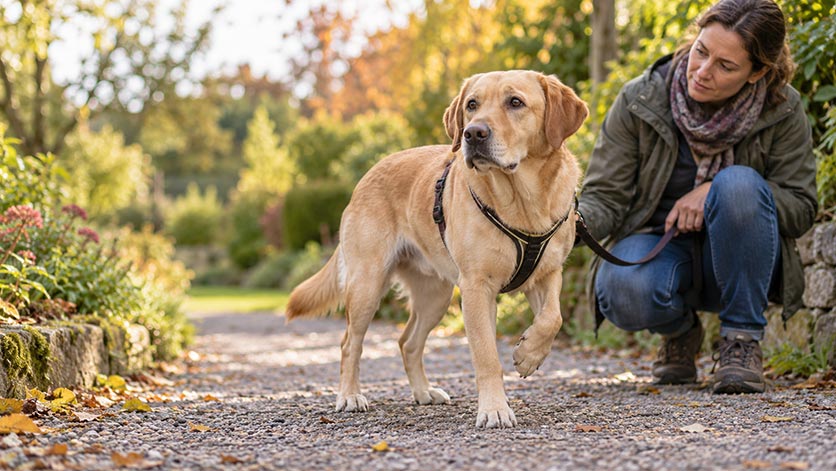
Sometimes a change in gait initially looks like ordinary limping. However, if the paw turns under, your dog drags a leg behind him or suddenly has difficulty standing up, the nerves or spinal cord may be involved.
New neurological symptoms like these require immediate veterinary assessment. This is especially important if your dog's condition is deteriorating quickly or if problems with urination also occur.
Observe Mild Limping Only for a Short Time
Even with mild lameness, contacting your veterinary practice is advisable.
The commonly mentioned 24-hour period is not a waiting rule for every limping dog. Brief observation may only be appropriate if your dog is still putting weight on the leg, otherwise appears well and shows no warning signs, ideally after receiving advice from your vet by phone.
If the lameness continues, your dog should be examined within 24 hours at the latest. If the condition worsens, seek veterinary help sooner. Recurrent limping should also be investigated.
What Can Cause Sudden Limping in Dogs?
Foreign Objects Between the Toes
After walking through long grass, it is worth checking between your dog's toes. Grass awns can become trapped there. These sharp plant parts may penetrate the skin and cause inflammation or abscesses.
Frequent licking and swelling of the paw can sometimes be signs of this problem.
A loose piece of plant material caught in the fur can be removed carefully. However, if it has already penetrated the skin or the area is swollen, leave removal to the veterinary practice.
Trying to probe a wound with tweezers can damage tissue and push the foreign object deeper or make it even harder to reach. Even if very little is visible externally, a grass awn may already be sitting beneath the skin.
Injured Paw Pads or a Torn Claw
A cut paw pad, a burn caused by hot ground or a torn claw can make every step painful.
These injuries are not always immediately visible because they may be hidden by fur or located between the toes. Check the underside of the paw as well as the claws, provided your dog calmly allows you to do so.
If a paw pad is bleeding, you can gently apply pressure using a clean compress or clean cloth.
Heavy or persistent bleeding requires immediate veterinary attention. Leave deeply embedded splinters in place.
Even relatively small paw-pad injuries can repeatedly reopen when your dog walks on them and should therefore be assessed by a vet.
Strains and Other Muscle or Tendon Injuries
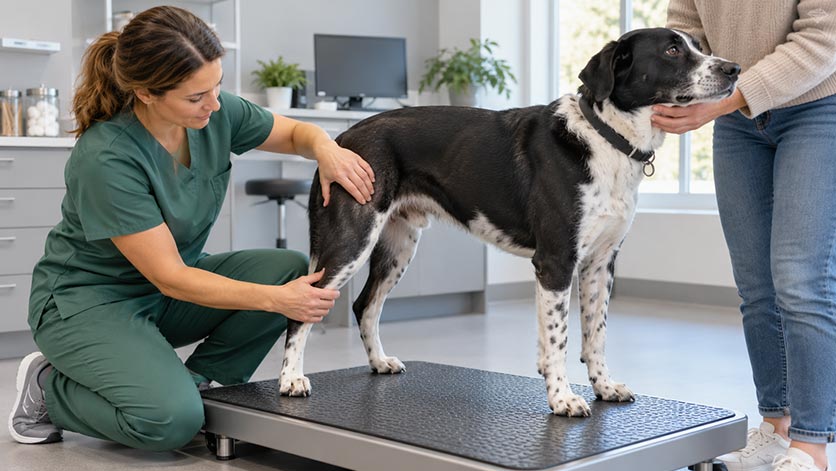
Sudden braking during play or an awkward jump can injure muscles and tendons.
Active dogs may, for example, suffer injuries involving the iliopsoas muscle group around the hip and thigh. These injuries can cause sudden or persistent lameness, while there may be no clearly visible external injury.
If your dog starts limping immediately after playing, this is useful information for the veterinary examination. However, it does not prove that your dog has simply strained a muscle.
Describe the movement or incident you observed as accurately as possible instead of trying to determine the cause yourself.
A Cruciate Ligament Problem in the Hind Leg
The cranial cruciate ligament stabilises the knee joint. If it becomes partially or completely damaged, your dog may suddenly avoid putting weight on one hind leg.
Some dogs also have difficulty getting up or begin sitting in an unusual position.
In dogs, cruciate ligament disease often develops gradually as the ligament degenerates over time. Therefore, the first visible symptoms during play do not necessarily mean that a previously healthy ligament was torn by one single jump.
A partial injury can also cause symptoms.
Whether surgery or another form of treatment is appropriate depends on factors such as knee instability, the dog's size and level of activity. This can only be determined after a veterinary examination.
A Kneecap That Slips Out of Position
Perhaps you have seen this pattern before: your dog takes a few steps on three legs and then suddenly uses the affected hind leg normally again.
One possible cause is patellar luxation. In this condition, the kneecap moves out of its normal position.
It occurs particularly often in smaller dog breeds, although larger dogs may also be affected.
Once the kneecap slides back into place, the dog's gait may immediately appear normal again. If this keeps happening, however, a veterinary examination is important.
Temporary normal movement does not indicate how severe the change in the knee joint may be.
Do not attempt to push the kneecap back into position yourself.
Osteoarthritis or Changes in the Hip and Elbow
Osteoarthritis in dogs usually develops gradually. Symptoms sometimes only become obvious when the dog finds it difficult to get up or begins noticeably protecting one leg.
Joint pain, reduced mobility and swelling may occur.
Osteoarthritis can also develop as a consequence of other joint disorders.
These conditions include developmental problems such as elbow dysplasia. They affect the development and interaction of structures within the joint and can already become noticeable in young dogs.
For this reason, limping in an oldr dog should not simply be blamed on age, while limping in a young dog should not automatically be dismissed as the result of playing too hard.
It is helpful to tell your veterinary practice whether you had noticed any changes before the current episode.
Has your dog recently taken longer to get out of his bed? Has he started avoiding jumping?
Observations like these can help complete the overall picture.
Conditions During Growth
A young dog that suddenly starts limping may be suffering from panosteitis.
This is a painful condition affecting the long bones and is particularly common in young, rapidly growing dogs.
The lameness may shift from one leg to another and can begin without any obvious injury.
The everyday expression “growing pains” may make the problem sound like something that will simply disappear by itself.
However, that does not explain what is actually happening in an individual dog.
Other bone and joint diseases are also possible at this age. A veterinary examination is needed to determine the cause.
Problems Involving the Nerves or Spine
A dog may develop an abnormal gait even when the problem is not located in the paw or a joint.
Disorders involving the spine, spinal cord or nerves can interfere with the control of movement.
Possible signs include weakness, an unsteady gait or a paw dragging across the ground.
Some of these conditions cause severe pain, while others mainly cause movement problems.
A dog that still looks alert and cheerful is therefore not necessarily free from a serious condition.
A veterinary neurological examination can help distinguish these problems from orthopaedic causes.
Inflammation and Other Serious Diseases
Joint inflammation can also cause lameness.
A bacterial joint infection may, for example, cause swelling, pain, fever and a significant deterioration in the dog's general condition.
Immune-mediated diseases can also affect several joints.
The list of possible causes also includes tumours affecting bones or joints.
The way your dog walks alone cannot tell you whether such a disease is present.
Persistent or worsening lameness therefore requires targeted investigation, even if no accident or injury was observed.
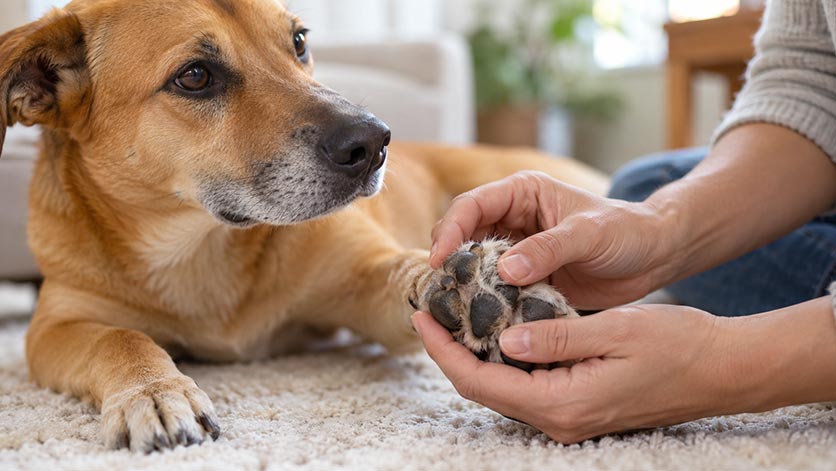
A careful examination of the paw may reveal visible injuries or foreign objects.
What You Can Do Until Your Dog Is Examined
Stop Physical Activity and Keep Daily Activity Calm
End the walk as soon as you notice that your dog is limping.
Until the cause has been clarified, avoid ball games, jumping and other strenuous activity.
For short essential trips outside, keep your dog on a lead.
At home, provide a quiet resting place where he does not have to keep getting up.
One practical tip is to place his water bowl within easy reach of his resting place.
When contacting the veterinary practice, have information such as your dog's age, weight and existing medical conditions ready.
If you have a large dog that is unable to walk, ask the veterinary team how to transport him safely and arrange for someone to help you.
Carefully Examine the Paw
If your dog allows you to touch the paw, examine it in good lighting.
Look between the toes, inspect the paw pads and check every claw.
A second person may be able to help keep your dog calm.
If your dog pulls the paw away or becomes restless, stop.
Even a normally gentle and familiar dog may snap when in pain.
The examination should be limited to looking and gently touching.
You do not need to move a painful joint through its range of motion just to provide the vet with more information.
If possible without causing stress, take a photo of any visible swelling or injury.
Do Not Give Painkillers Without Veterinary Advice
Ibuprofen, paracetamol and other medicines from your home medicine cabinet should never be given to your dog without veterinary instructions.
Painkillers intended for humans can cause severe harm to dogs.
Leftover medication prescribed for another animal is not a safe alternative either.
Which medicine is appropriate depends on factors including existing medical conditions and other medications your dog may already be taking.
If your dog has already received medication, tell the veterinary practice the name of the product, the amount given and the time it was administered.
If your dog has received a human medication that was not prescribed by a vet, contact an emergency veterinary service immediately and keep the packaging available.
Only a proper examination can determine which treatment is suitable for the cause of the lameness.
How the Veterinary Practice Determines the Cause
The examination begins with the information you provide.
“Since this morning” is a useful starting point, but a more precise description would be:
“Yesterday evening he was walking normally. This morning after getting up, he barely put any weight on his right hind leg.”
Also mention whether you saw your dog fall or have an accident and whether similar symptoms have occurred before.
Depending on the findings, the vet will examine the paws, legs and joints.
If there are appropriate signs, a neurological examination may also be carried out.
X-rays can reveal changes affecting bones and joints, but they do not answer every question.
For certain muscle or tendon problems, ultrasound may be useful.
Neurological diseases may require more advanced diagnostic procedures such as an MRI scan.
Treatment depends on the underlying cause.
In the case of a cruciate ligament problem, for example, the stability of the knee joint will be taken into account.
For osteoarthritis, appropriate pain management and a carefully adjusted level of physical activity may form part of the treatment plan.
Ask the veterinary practice for specific instructions for home care:
How long may your dog walk for?
Which movements should be avoided?
When is the next follow-up appointment required?
Clear instructions make it much easier to follow the treatment plan in everyday life.
Frequently Asked Questions About Dogs That Suddenly Start Limping
My Dog Is Limping but Does Not Seem to Be in Pain. Is It Harmless?
The absence of whining is not enough to conclude that the problem is harmless.
A dog may show pain through a protective posture or changes in behaviour.
Neurological conditions can also affect movement without obvious pain being the main symptom.
The examination and the development of the symptoms are what matter.
What Does It Mean If My Dog Is Limping on a Front Leg?
Possible causes affecting the front leg include injuries to the paw or claws, muscle problems and diseases involving the shoulder or elbow.
Knowing whether the front or hind leg is affected is useful during the examination, but it does not establish the diagnosis.
Also note which side is affected.
Why Does My Dog Only Limp Occasionally?
Intermittent limping can have several different causes.
With patellar luxation, for example, the dog may begin walking normally again once the kneecap returns to its normal position.
Other conditions can also cause symptoms that come and go.
Make a note of when the change occurs and have recurring episodes of lameness assessed by a veterinarian.
Can My Dog Continue Going for Walks If He Still Wants to Walk?
Until the problem has been assessed, restrict activity to short, necessary walks on a lead.
The fact that your dog still walks to the door or wants to chase a ball does not mean that physical exercise is safe.
After the veterinary examination, follow the activity recommendations given by your vet.
This article provides general guidance and does not replace a veterinary examination.